A badminton-like game was known in ancient Greece and Egypt - a game called battledore and shuttlecock - in which two players hit a feathered shuttlecock back and forth with tiny rackets.
The game was played in India during the 18th Century, at which time it was called "Poona" . In the 1860s it was adopted by British Army officers stationed in India. The officers took the game back to England, where it became a success at a party given by the Duke of Beaufort in 1873 at his estate called "Badminton" in Gloucestershire.
1. El terreno de juego: Es de forma rectangular (64 metros de largo), con una zona de marca en cada lado (18 metros cada una). Es decir, 100 metros en total.
2. Inicio del juego: Los equipos constan de 7 jugadores de campo más reservas. Cada punto empieza con los equipos situados en la línea frontal de su zona de marca. El equipo defensor lanza el disco (hace el pull) al equipo atacante.
3. Puntuación: Se consigue un punto cada vez que el equipo de ataque completa un pase dentro de la zona de marca del equipo defensor. A continuación se inicia un nuevo punto.
4. Movimiento del disco: El disco puede desplazarse en cualquier dirección completando así un pase a un jugador del mismo equipo. No se puede correr con el disco en las manos. La persona que tiene el disco (lanzador) tiene 10 segundos para pasarlo. El jugador que hace la defensa sobre el lanzador (marcador) cuenta en voz alta los segundos que van pasando.
5. Cambio de posesión. Razones para perder la posesión del disco:
- Tirarlo: el lanzador falla el lanzamiento y el disco cae al suelo.
- Soltarlo: el receptor no atrapa el disco y este cae al suelo.
- Bloqueo: un defensor golpea el disco en el aire y este cae al suelo.
- Intercepción: un defensor atrapa el disco en el aire.
- Fuera del campo: el disco sale del campo, toca un objeto que se encuentra fuera del campo o es atrapado por un jugador que lo atrapo fuera del campo.
- Pararse: un atacante no lanza el disco cuando el conteo del defensor llega a 10 segundos.
6. Sustituciones: Solo se pueden hacer cambios cuando se acaba el punto o si ha habido una lesión.
7. Contacto: No está permitido el contacto físico entre jugadores. Si lo hubiera, se incurriría en una falta. Tampoco están permitidos los bloqueos y otros tipos de obstrucciones.
8. Faltas: Cuando hay contacto entre jugadores se produce una falta. Si la falta provoca la pérdida de posesión del disco, el juego se reinicia mantenido dicha posesión. Si no hay acuerdo entre los jugadores que cometen/reciben la falta, la jugada vuelve a su inicio.
9. Arbitraje: Cada jugador es responsable de marcar las faltas que crea necesarias y de resolver las disputas que puedan surgir. No existe la figura del árbitro.
10. Espíritu del juego: El Ultimate pone énfasis en la deportividad y el juego limpio. Se alenta a jugar de forma competitiva, pero nunca a expensas del respeto entre jugadores, el cumplimiento de las reglas y el disfrute propio de la práctica de este deporte.
11. Tiempo muerto y medio tiempo: Se permite a cada equipo poder pedir 2 tiempos muertos por cada medio tiempo del partido. Se considera el medio tiempo cuando uno de los equipos alcanza el marcador intermedio en la cuenta. Puesto que la mayoría de los juegos se juegan a los números impares, el número para media jornada se redondea hacia arriba. Por ejemplo, si el juego está a 15 puntos, la mitad viene cuando un equipo alcanza los 8 puntos.
Para terminar os dejo unos cuantos vídeos más para entender mejor este deporte. Los tipos de lanzamiento, jugadas espectaculares, etc...
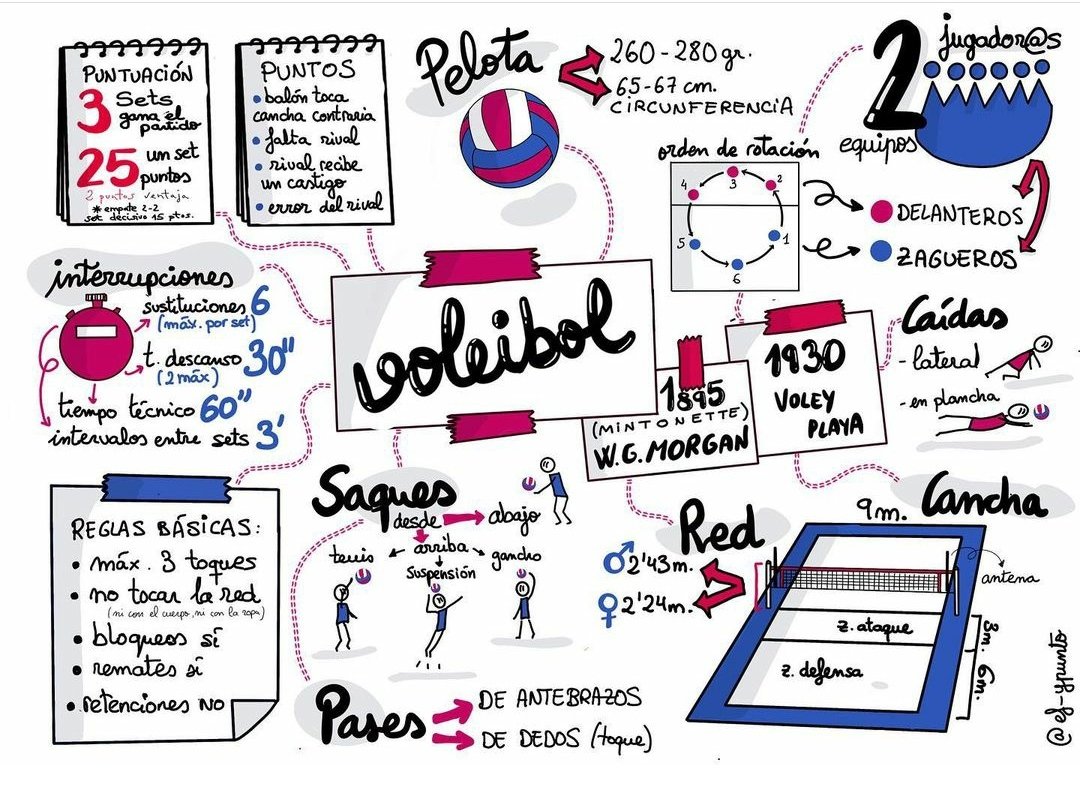
Game played by two teams, usually of six
players on a side, in which the players use their hands to bat a ball back and
forth over a high net,
trying to make the ball touch the court within the opponents’ playing area
before it can be returned. To prevent this a player on the opposing team bats
the ball up and toward a teammate before it touches the court surface—that
teammate may then volley it back across the net or bat it to a third teammate
who volleys it across the net. A team is allowed only three touches of the ball
before it must be returned over the net.
History
Volleyball was invented in 1895 by William G. Morgan,
physical director of the Young
Men’s Christian Association (YMCA) in Holyoke, Massachusetts. It
was designed as an indoor sport for businessmen who found the new game of basketball too vigorous. Morgan
called the sport “mintonette,” until a professor from Springfield College
in Massachusetts noted
the volleying nature of play and proposed the name of “volleyball.” The
original rules were written by Morgan and printed in the first edition of
the Official Handbook of the Athletic League of the Young Men’s
Christian Associations of North America (1897). The game soon proved
to have wide appeal for both sexes in schools, playgrounds, the armed forces,
and other organizations in the United States, and it
was subsequently introduced to other countries.
In 1916 rules were issued jointly by the YMCA and the National
Collegiate Athletic Association (NCAA). The first nationwide tournament in
the United States was conducted by the National YMCA Physical Education
Committee in New
York City in 1922. The United States Volleyball Association (USVBA)
was formed in 1928 and recognized as the rules-making, governing body in the
United States. From 1928 the USVBA—now known as USA Volleyball (USAV)—has
conducted annual national men’s and senior men’s (age 35 and older) volleyball
championships, except during 1944 and 1945. Its women’s division was started in
1949, and a senior women’s division (age 30 and older) was added in 1977. Other
national events in the United States are conducted by member groups of the USAV
such as the YMCA and the NCAA.
Volleyball was introduced into Europe by American troops
during World
War I, when national organizations were formed. The Fédération
Internationale de Volley Ball (FIVB) was organized in Paris in 1947 and moved
to Lausanne, Switzerland, in 1984.
The USVBA was one of the 13 charter members of the FIVB, whose membership grew
to more than 210 member countries by the late 20th century.
International volleyball competition began in 1913 with the
first Far East Games, in Manila.
During the early 1900s and continuing until after World War II,
volleyball in Asia was
played on a larger court, with a lower net, and nine players on a team.
If you want to know more about VOLLEYBALL RULES, watch this video.
VOLLEYBALL SETTING TECHNIQUE.
- Setting is the most important and technical skill in volleyball after passing.
- Setting is playing the ball with your hands overhead.
- It cannot be carried or double contacted. They are both illegal.
- Put your hands on your hips like you are upset with me, keep your hands in the same possition and put them over your forehead.
- When the ball hits your wrists, it flexes them in slightly and you press them out with a super man or super woman finish.
VOLLEYBALL PASSING TECHNIQUE.
VOLLEYBALL PASSING TECHNIQUE. "BUMP".
- You should wait with one of your foot forward, and your hands in a neutral “ready” position.
- As the balls comes, your hands go towards the ball and clasp them together.
- Put one hand flat in the other, thumbs parallel and pointing down.
- Get arms straight and platform perfect.
- Legs are bend, as the ball comes is a slight move forward withe the hips.